Our Management Approach to Sustainability and Climate
Governance
1. Sustainability as a Governing Principle
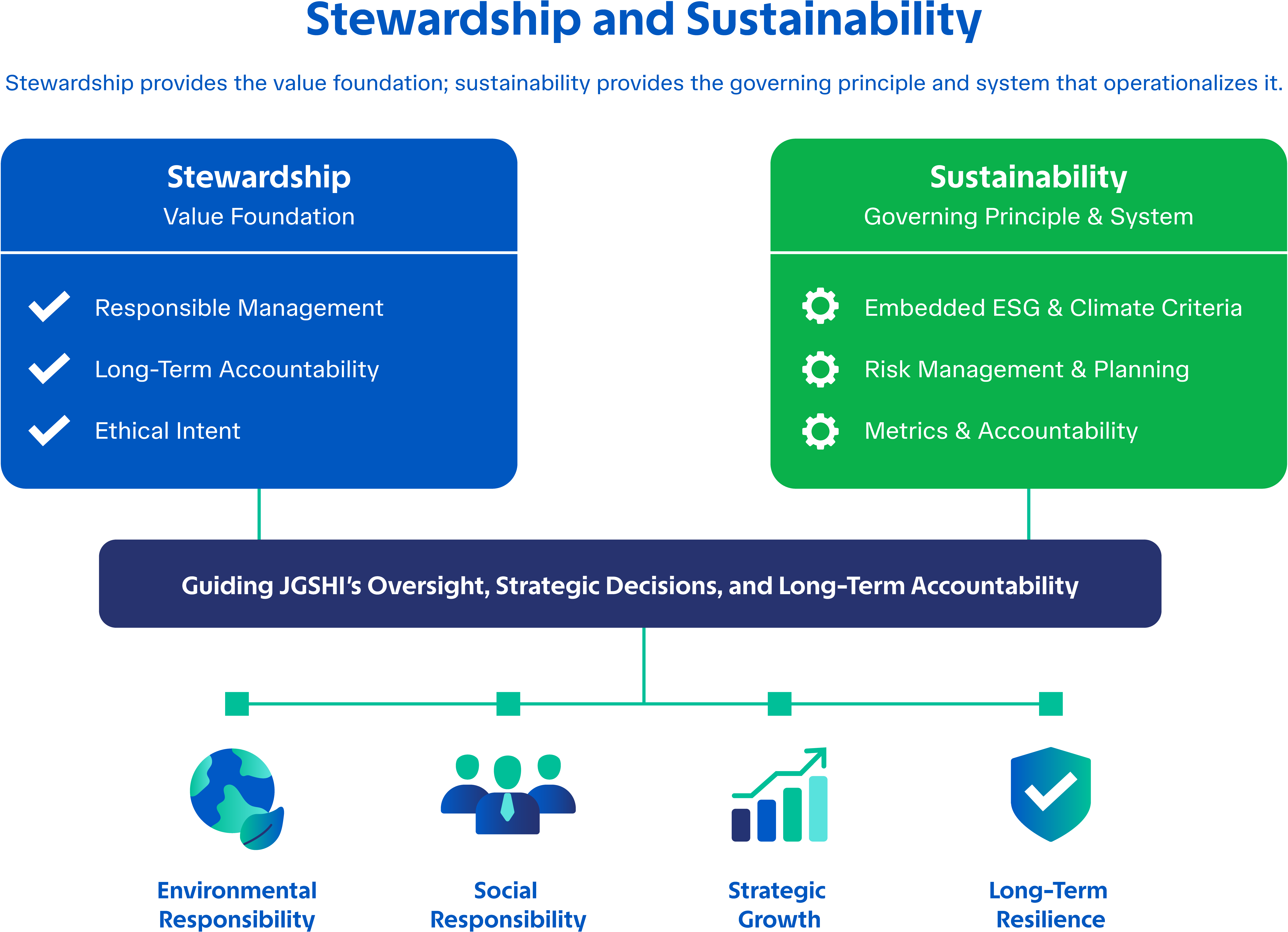
Sustainability as a governance principle is anchored in JGSHI’s core value of Stewardship, which emphasizes responsible management of resources and long‑term accountability for impacts. Stewardship provides the values and intent, while sustainability provides the governing discipline and system through which these values are operationalized across the Group.
Together, they strengthen oversight, uphold ethical conduct, and reinforce long‑term organizational resilience.
2. Sustainability Governance


Click the diagram to view
2.1 Board of Directors
The Board provides independent oversight and ensures that sustainability and climate considerations remain aligned with the Group’s Objectives, Goals, Strategies, and Measures (OGSM).
2.2 Audit, Related Party Transactions & Risk Oversight Committee (AURROC)
AURROC oversees financial reporting, internal controls, and the Group’s Enterprise Risk Management (ERM) framework, ensuring the Board is fully informed of material exposures, including sustainability and climate-related risks.
2.3 Governance, Nomination, Remuneration & Sustainability Committee (GNRSC)
Working alongside AURROC, the GNRSC oversees corporate governance principles and the economic, environmental, social, and governance (EESG) aspects of sustainability. It reviews and recommends approval of the Sustainability and Climate Disclosure Report and evaluates management’s performance in leveraging climate opportunities.
2.4 Executive Leadership Council
The Executive Leadership Council, which includes Corporate Center Unit Heads and Strategic Business Unit CEOs, tackles sustainability and climate-related risks and opportunities. Under the leadership of the President and CEO, they formulate and implement strategies to manage these risks and leverage opportunities for the organization.
The President and Chief Executive Officer (CEO) defines the overall strategic direction for the conglomerate, encompassing our approach to sustainability and climate action. The CEO plays a pivotal role in driving initiatives, managing risks, and ensuring transparent reporting on our performance.
The Chief Finance and Risk Officer (CFRO) manages our ERM processes, creating a strong framework for handling sustainability and climate-related risks, along with other key business risks. The CFRO communicates significant risk exposures and mitigation plans to AURROC.
The Chief Human Resources Officer (CHRO) oversees the conglomerate’s sustainability efforts, including developing climate and sustainability strategies, leading disclosure initiatives, and embedding sustainability into the organization’s culture.
The Sustainability Head reports to the CHRO and is responsible for designing and leading the development of our Climate Resilience and Transition plans, identifying relevant risks and opportunities, and helping SBUs achieve related targets. The Sustainability Head provides strategic direction, builds stakeholder relationships, and monitors performance. The Sustainability Head collaborates with the ERM and Corporate Strategy teams to integrate sustainability and climate-related risks and opportunities into the Company’s strategy and risk management framework. Additionally, the Sustainability Head engages with relevant internal and external stakeholders to discuss and build support for key sustainability-related initiatives and policies.
The Chief Strategy Officer (CSO) ensures that sustainability and climate considerations are integrated into the company’s broader business strategy and that ecosystem synergies are maximized. The CSO also participates in investor conferences, roadshows, and other engagement platforms to communicate the company’s strategy, goals, and progress directly to investors.
The CHRO and the CSO jointly oversee the development and integration of our sustainability and climate transition plan into our businesses, including setting targets and assessing risks and opportunities.
The Risk Council, composed of Corporate Center Unit (CCU) Heads, plays a crucial role in establishing a sustainability and climate risk register. They initiate enterprise-wide discussions on risks and provide feedback to risk owners. In collaboration with the CFRO, the Risk Council combines expertise and guidance with strategic direction and risk oversight to ensure effective management of both business and sustainability risks.
The Strategic Business Units (SBUs) are essential to implementing ERM, sustainability, and climate resilience strategies. SBU leadership continuously refines risk management strategies to address challenges within their respective business areas.
3. Governance Capability and Continuous Improvement
Directors undergo structured governance and sustainability training, including committee‑specific orientation, ESG capability programs, and climate‑related sessions—reinforcing JG Summit’s governance culture.


Sustainability and Climate Risk Management
JG Summit embeds sustainability and climate risks within its Enterprise Risk Management (ERM) framework. This ensures ESG and climate considerations are treated with the same rigor as operational and financial risks.
The Board, through AURROC, oversees the ERM framework and reviews risk appetite, mitigation plans, and exposure levels. These are published through JG Summit’s Annual & Sustainability Report, which is transitioning to full IFRS S1/S2 alignment.

Strategy, Metrics, and Targets
1. Developing the Sustainability Strategy
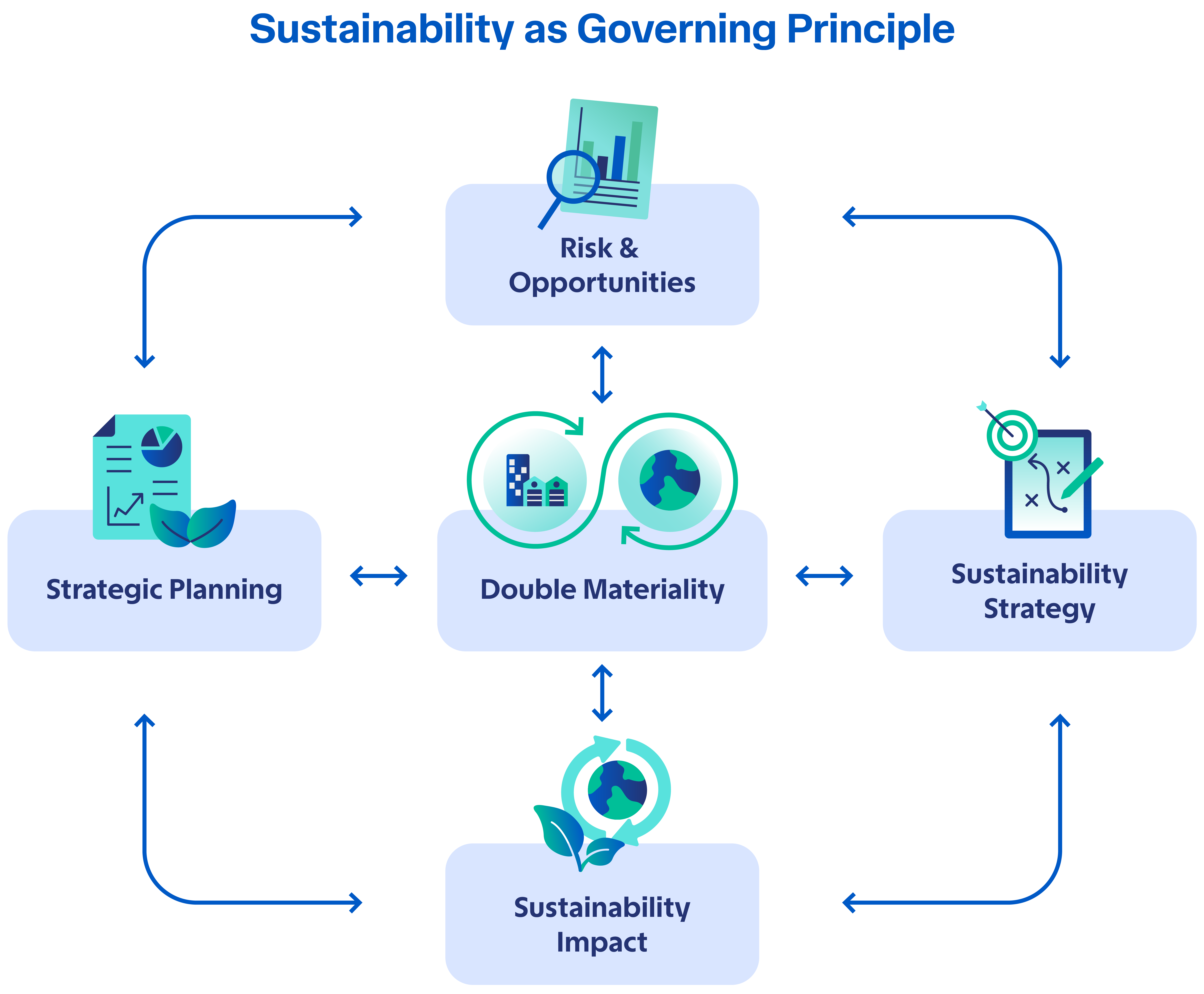
Our Sustainability Strategy is developed through a structured cycle that begins with identifying material risks, opportunities, and impacts across the portfolio. A Double Materiality analysis provides the foundation, ensuring that both financial materiality (risks and opportunities) and impact materiality (effects on stakeholders and the environment) are fully considered. These insights feed into strategic planning and guide the formulation of the Sustainability Strategy. Sustainability, as a governing principle, ensures that this strategy is embedded into decision‑making and leads to meaningful, measurable sustainability impacts.
1.1 OGSM as JGSHI’s Strategic Planning Backbone
JGSHI follows a disciplined, long-range planning process anchored on the OGSM (Objectives, Goals, Strategies, Measures) framework. This approach creates a clear cascade—from defining the Group’s purpose and long-term vision, to setting five-year financial and non-financial goals, to determining strategic choices and the actions required to achieve them. Guided by a unified direction, SBUs craft and refine their own sector‑specific strategies and targets that contribute towards the realization of the conglomerate’s overall ambition.
With 2025 serving as a rebasing year, JG Summit refreshed its long-term strategy, charting its path for 2026 up to 2030. As part of this, the Group is also evolving its governance structures to effectively monitor and ensure the delivery of SBU commitments, with Value Creation Plans (VCPs) serving as performance contracts between the Parent Company and its major subsidiaries: CEB, URC, and RLC. These VCPs complement the OGSM by providing clear prioritization and quantification of three to five battlegrounds that would deliver substantial value uplift over the next five years. Each battleground is supported by a roadmap of initiatives and metrics to effectively track progress. In line with Sustainability being a governing principle within the OGSM, climate and broader ESG considerations are taken into account in developing, measuring, and prioritizing specific initiatives in the VCPs. Lastly, management scorecards and incentives are also being redesigned to ensure these are anchored on metrics and targets documented in the VCPs.
1.2 Double Materiality as Input to Sustainability Strategy
Consider:
- Financial impact to business
- Impact to stakeholders
- Employee perceptions

- Identification of key focus areas based on top risks
- Development of strategy, metrics, and targets

- Implementing feedback loop
- Adapting the strategies based on changing landscape
Insights from double materiality, including financial impact evaluations, stakeholder expectations, and employee perceptions, shape the sustainability strategy by:
- Identifying priority sustainability themes;
- Guiding resource allocation;
- Establishing measurable climate and ESG targets; and
- Aligning SBU‑specific plans with Group-wide direction
The enhanced sustainability strategy and consolidated climate and ESG targets will be published in 2026.
1.2.1 Financial Impact
JGSHI assesses sustainability and climate‑related risks that may materially impact financial performance through:
- Analysis of climate and sustainability risks
- Prioritization based on financial impact and likelihood
- Mapping risks to SASB industry topics across CEB, URC, and RLC
- Climate scenario analysis for transition and physical risks
1.2.2 Stakeholder Impact
JGSHI also evaluates how sustainability issues affect employees, customers, communities, and regulators. This ensures strategic choices reflect stakeholder expectations and support long‑term trust.
Employee Insights on Environmental & Social Responsibility
Purpose of the Listening Exercise
JGSHI engaged employees to understand perceptions on environmental and social responsibility and to ensure that their views inform the next cycle of our sustainability strategy. This aligns with IFRS S1’s emphasis on stakeholder‑informed strategy formation and IFRS S2’s requirements for understanding organizational readiness for climate‑related objectives.
Key Findings
- Strong recognition of Environmental and Social (E&S) initiatives: Employees consistently perceive JGSHI as environmentally responsible, socially engaged, and positively contributing to communities.
- High values alignment: Most employees report that their personal values align with JGSHI’s environmental and social commitments, reinforcing cultural cohesion and stewardship.
- Appetite for deeper involvement: Employees want more opportunities to participate in E&S activities, especially those that use their professional skills.
- Supportive leadership: Leadership is viewed as ethical, inclusive, and clear in providing direction—an important factor for embedding sustainability within governance and strategic planning.
- Barriers identified: Competing priorities and limited budgets were highlighted as common challenges to contributing more meaningfully.
How Employees Shape Our Sustainability Approach
Employee insights will inform JGSHI’s double materiality assessment and the development of Group‑level ESG and climate targets. Findings will be used to:
- Strengthen internal communication and participation platforms
- Shape employee‑led and skills‑based volunteerism
- Clarify leadership expectations and visibility on ESG priorities
- Address resourcing gaps to enable a more meaningful contribution
- Anchor culture programs on shared values and sustainability stewardship
1.2.3 Scenario‑Informed Strategic Choices
Between 2023 and 2024, all Strategic Business Units (SBUs) undertook a coordinated series of Sustainability Risk Assessments, Transition Risk Assessments, and Physical Climate Risk Assessments. These activities were designed to align with IFRS S1 and IFRS S2 expectations by systematically identifying material sustainability‑ and climate‑related risks and opportunities, assessing their potential financial and operational impacts, and evaluating the resilience of SBU strategies under different forward‑looking conditions.
Insights from these assessments inform sector‑specific strategic responses across the portfolio, such as:
These strategic actions are reflected in the S — Strategies and M — Measures components of OGSM or the SBU Sustainability Strategy, ensuring that sustainability risks and opportunities shape business direction, resource allocation, and performance accountability.
2. Sustainability Strategy, Metrics, and Targets

- Governance, Board oversight, and compliance
- Risk management, controls, cybersecurity, and data resilience
- Climate governance and climate-risk oversight
- 100% SBUs compliant with governance templates/expectations (FY2026)
- 100% risk and controls attestation (FY2027)
- Satisfactory audit reports and ESG ratings

- Environmental and climate guardrails
- Environmental compliance expectations
- 100% SBUs reporting minimum environmental metrics (FY2026)
- Zero major environmental non-compliance incidents (FY2026)
- Post-consumer plastic recovered/diverted by ≥80% (2030)
- GHG emissions intensity by sector
- Water intensity per sector
- 100% SBU climate-risk assessments and plans (2028)

- Employee engagement and safety
- Community impact
- Maintain or improve employee engagement score (FY2026)
- Zero fatalities and Lost Time Incidents (LTIs)
- 100% SBUs with community focus areas and targets (FY2026)